
The Fluvial, Eolian & Shallow-Marine Research Group focuses on multi-scale characterization and modelling of subsurface sedimentary successions, across fluvial, aeolian, lacustrine, and shallow-marine environments. The group combines classic and quantitative facies analysis, sequence stratigraphy, and analogue studies with computational methods including machine learning, geostatistical modelling and forward stratigraphic modelling. Grounded in fundamental sedimentology and stratigraphy, these activities directly support key energy transition applications, such as carbon capture and storage and geothermal energy use.
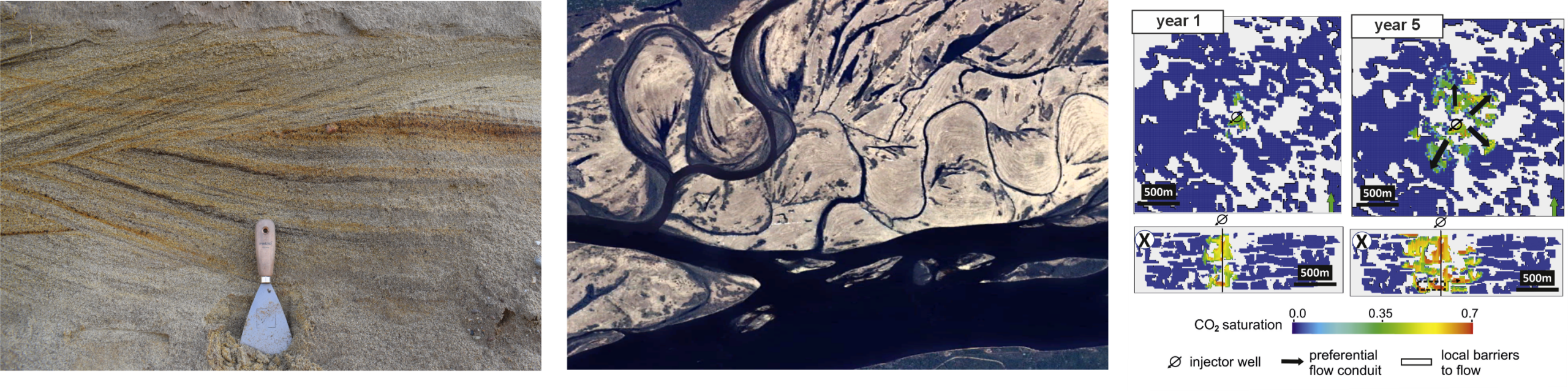
Summary of Phase 7 Research Programme — Fluvial, Eolian & Shallow-Marine Research Group
- Theme 1: Development of quantitative facies models for fluvial, aeolian and shallow-water systems
- Theme 2: Analogue studies of subsurface architecture and facies heterogeneity
- Theme 3: Meta-analyses for assessing the importance of controls on sedimentary architecture
- Theme 4: Improved use of geophysical soft data for constraining clastic reservoir models
- Theme 5: Machine-learning approaches to interpretations of borehole data
- Theme 6: Generation of a training image library for MPS geocellular modelling
- Theme 7: Controls on the static connectivity of aeolian dune and interdune deposits
- Theme 8: Influence of sedimentary heterogeneity on the performance of low-enthalpy geothermal applications
- Theme 9: Impact of sedimentary architectures on carbon capture and underground storage
- Theme 10: Flow-based upscaling of aeolian sedimentary heterogeneity
- Theme 11: Upstream and intra-basinal controls on channel avulsion and resulting channel-body geometry and connectivity
- Theme 12: Sequence stratigraphy of fluvial systems in tectonically active basins
- Theme 13: Fluvial-aeolian interactions
- Theme 14: Geometry and static connectivity of lacustrine and marine architectural elements
- Theme 15: Relationships between facies heterogeneity, diagenetic processes and petrophysical characteristics
- Theme 16: Facies control on the thermal conductivity of fluvial successions used for shallow-geothermal operations
- Theme 17: Prediction of facies heterogeneity and brine migration pathways for CCS risk assessment around legacy wells
- Theme 18: Integrating fluvio-aeolian architecture and fault dynamics: 3D seabed-to-subsurface modelling for secure CO2 storage
- Theme 19: Next-generation sequence stratigraphy models to better understand the nature of the sedimentary record